How a Real Estate Man Turned His Backyard Into a Fig Empire — One Cutting, One Curse Word, and One New England Winter at a Time
By Chef Walter Potenza
I have walked through a lot of doors in my life expecting dinner and finding a story instead. But I never expected to walk through a perfectly ordinary front door in Pawtucket, Rhode Island, and find myself standing before a house that, from the street, looks like every other well-kept colonial on the block. Then, in the backyard, I found the Mediterranean basin. That contrast is the story: what looks ordinary from the curb hides something remarkable behind the fence. Dan Ripley is the man behind it.
Dan appraises real estate for a living. He reads deeds, inspects properties, analyzes comparables, reviews records, and prepares detailed documents for a final estimated value. Nothing in his day job suggests a man secretly cultivating forty-some fig trees (more or less) behind a privacy fence, coaxing fruit from a climate that seems to resent the idea actively. Yet there he was, the first time I met him, practically vibrating with the kind of joy I often see in cooks when a sauce finally breaks correctly instead of the other way around. That energy made me want to know how this started.
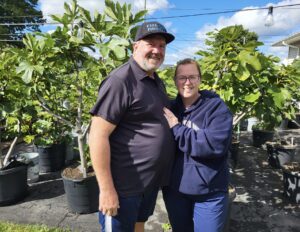
I should explain how we met, because it says everything about how this story started. Dan’s wife booked him into a class at my Cooking School in Cranston, Rhode Island — I suspect as a gift. I also suspect it was a gentle hint that a man who talks about Ficus carica at the dinner table might enjoy an evening among food-lovers with different food interests. That’s how the fig conversation began.
We began talking about figs, and I shared a story about my grandfather’s trees in Abruzzo, Italy, and Dan lit up like I’d handed him a winning lottery ticket. From that moment on, I realized he’d researched figs deeply, and sharing that rich knowledge made him happy.
“From the curb, it’s a colonial like any other. Behind the fence, it’s the Mediterranean.”
A hobby that grew legs — and roots
Dan’s fig story, like so many good unusual stories, began in the 90s. Initially a hobbyist gardener, he eventually met a man named Carlos who also shared a passion for figs. About 11 years ago, cultivation became a full passion. He did not go to school to become an agronomist or study horticulture. Instead, he created Figland Foodies because people asked questions about figs—folks who wanted fig trees without fancy equipment or expertise—and those questions led him deeper into helping others with their concerns. He’d always loved food, loved the particular pleasure of discovering a flavor he’d never tasted before, and somewhere in that restlessness he planted his first fig tree. One tree became three. Three became a dozen. A dozen became, as far as I can tell, an entire clandestine orchard that most of his neighbors probably have no idea exists.
What started as a pastime has become something closer to a second vocation. Dan researches fig varieties the way I research old regional recipes — obsessively, and with a healthy suspicion of anyone who tells him something can’t be done. He tracks down cultivars from Italy, the Balkans, Turkey, North Africa, and beyond, hunting for the genetics that might survive a New England February. He talks about breba crops and main crops the way sommeliers talk about vintages. And when he finds something interesting, he doesn’t hoard it — he propagates it, shares cuttings, and drags half of Pawtucket into his obsession one root cutting at a time.
A fruit older than agriculture itself
It helps that figs are, frankly, one of the most historically loaded fruits a person can grow. Archaeobotanists have found carbonized figs at a Neolithic site in the Jordan Valley dating back roughly 11,400 years — possibly making the fig one of humanity’s first cultivated crops. The Egyptians carved figs into tomb art as offerings for the afterlife. The Greeks considered them sacred to Dionysus. The Romans planted them everywhere the legions went, which is a fair description of how Ficus carica ended up circling the Mediterranean basin and, eventually, a fenced yard off a side street in Pawtucket. That history helps explain why Dan’s backyard feels bigger than it is.
Botanically, the fig is a magic trick. What we eat isn’t technically a fruit in the conventional sense — it’s a syconium, an inverted cluster of tiny flowers blooming inside a fleshy, closed receptacle. Some varieties require a specialized wasp, Blastophaga psenes, to pollinate them through a tiny opening called the ostiole; the varieties Dan and most home growers favor are self-fertile ‘common type’ figs that need no wasp at all.
The technical side —or how to out stubborn a New England winter
This is where Dan stops being a hobbyist and starts sounding like an engineer. Figs are subtropical plants that would much prefer the winters of Naples to the winters of Rhode Island, and a hard freeze can kill unprotected wood right down to the ground. So the challenge becomes less about growing figs and more about out-stubborning the season. With that in mind, here’s how Dan does it.
Dan’s answer has been a running experiment in seasonal architecture: each plant sits in a large plastic container, with a single branch sprouting. He prunes to balance this year’s crop against next year’s wood, watches soil drainage carefully because figs despise wet feet, and has strong opinions about container size versus in-ground planting.
He treats a fig tree the way I treat a stock pot — something that rewards patience and punishes shortcuts.
None of this stays locked up in his own backyard, either. Dan has become the person other Rhode Islanders quietly call when their own fig tree looks sad, or when they inherited grandpa’s tree and have no idea what to do with it. He hands out cuttings, walks people through their first winter protection setup, and shows up at regional fig gatherings and competition events to compare notes, trade rare varieties, and — I suspect — win a friendly argument or two about ripening times. In the truest sense, he has become an ambassador for a fruit most of his neighbors only meet wrapped in prosciutto at a wedding. That wider reach helps explain why his work matters beyond one yard.
A neighborhood secret worth telling.
There is something wonderful about a man who spends his working hours in inspections, and his free hours arguing with a Rhode Island winter about whether a Mediterranean tree belongs here. Dan will tell you it shouldn’t. He will also tell you, with a grin, that it does anyway, because he refuses to let it not. That, to me, is the whole story of why people garden at all — not because the odds favor them, but because they’d rather lose to a February frost than never plant the tree. So that’s why this backyard feels worth telling.
So, the next time you drive past a quiet house in Pawtucket with nothing unusual about it from the curb, remember behind that fence. There may be a small piece of the Mediterranean, stubbornly, deliciously alive. After my interview, I realized that all I have learned cannot fit into one article. Figland Foodies is a personal concept developed after years of stubborn involvement. I will not do it justice to try to explain everything it takes here. It is much better if Dan explains it himself. You can find him on many social platforms, where he shares video presentations, and you will understand the man behind the passion.
From my perspective, I don’t have the know-how or the patience required to grow figs. To me, the fruit represents my grandfather’s passion for agriculture and the sweet moments I spent visiting his farm in Italy. However, I can share a great fig recipe for you to try. You will need two things: patience in the kitchen and great figs, and for those, you have to connect with Dan. He’ll be happy to help.
As I drove away, I was thinking about what I’d do with what’s hanging off those branches how to use figs in my kitchen- and here are some suggestions I envisioned.
My six ways I’d cook with what Dan grows.
- 1. Fichi al Prosciutto — the classic: ripe figs split and wrapped in Prosciutto di Parma, a drizzle of good olive oil, nothing else needed.
- 2. Grilled Figs with Gorgonzola and Honey — halved figs charred briefly on the grill, finished with crumbled gorgonzola and a thread of local honey.
- 3. Fig and Balsamic Crostini — toasted country bread, mashed fig and mascarpone, a reduction of balsamic vinegar, a whisper of black pepper.
- 4. Roast Pork Loin with Fresh Fig Agrodolce — pork roasted with a sweet-and-sour fig sauce built on red wine vinegar, shallots, and rosemary.
- 5. Fig and Walnut Crostata — a rustic, free-form tart with a short pastry crust, roughly cut figs, toasted walnuts, and a touch of orange zest.
- 6. Fig Leaf–Wrapped Ricotta with Autumn Fruit — fresh ricotta baked in fig leaves — yes, the leaves themselves carry a coconut-like aroma when heated — served with the fruit itself and a scatter of toasted almonds.
Figs and Walnut Crostata
A crostata is a traditional Italian open-faced tart made from a sweet, crumbly shor-tcrust pastry called pasta frolla, typically pressed into a round pan with the edges folded or crimped and sometimes finished with a lattice top, then filled with fruit preserves or jam. However, ricotta, pastry cream, fresh fruit, chocolate, and almond paste are also common; bake until golden, then serve at room temperature. This rustic crostata uses a buttery walnut pastry with fresh figs, honey, and lemon; it yields a free-form tart (9 to 10 inches) and serves 6 to 8 people.
Ingredients
Walnut pastry
1¼ cups (155 g) all-purpose flour, plus more for rolling
⅓ cup (35 g) finely ground walnuts
¼ cup (50 g) granulated sugar
¼ teaspoon fine salt
½ cup (113 g) cold unsalted butter, cut into small cubes
1 large egg yolk
2–3 tablespoons ice water
½ teaspoon vanilla extract, optional
Fig fillin
1½ lb (680 g) fresh ripe figs, stemmed and quartered
⅓ cup (65 g) light brown sugar
¼ cup (30 g) chopped toasted walnuts
1 tablespoon cornstarch
1 teaspoon finely grated lemon zest
1 tablespoon lemon juice
1 tablespoon honey
½ teaspoon vanilla extract
Pinch of salt
¼ teaspoon ground cinnamon or cardamom, optional
To finish
1 egg beaten with 1 teaspoon water
1–2 tablespoons coarse sugar, optional
Extra honey and softly whipped cream, mascarpone, or vanilla ice cream for serving
Make the dough
Put the flour, ground walnuts, sugar, and salt in a food processor and pulse until combined. Add the cold butter and pulse until the mixture looks like coarse crumbs, leaving a few pea-sized pieces of butter.
Mix in the egg yolk, the vanilla (if using), and two tablespoons of ice water; pulse only until the dough starts to clump together. Add the final tablespoon of water only if the mixture is still very dry. Place the dough on a surface, press into a disk, wrap, and refrigerate for at least 1 hour or up to 2 days.
Walnut pastry pairs well with figs because it adds a toasty flavor without overpowering the fruit. Recipes that use walnut pastry, or a fig filling with a touch of walnut, fit this combination.
Prepare and assemble
Preheat the oven to 400°F / 200°C and line the rimmed baking tray with parchment paper. Put the figs in a large bowl and gently mix with the brown sugar, chopped walnuts, cornstarch, lemon zest, lemon juice, honey, vanilla, salt, and, if desired, the spice. Then leave them for 10 minutes.
Take the chilled dough and roll it on a surface dusted with a little flour into a fairly flat circle, about ⅛ inch thick, then place it on the prepared baking sheet. Place the fig mixture in the center, leaving a 2-inch border. For a more refined appearance, place a few fig pieces cut-side up on top. Make loose pleats by folding the dough border over the filling, leaving the middle open. Brush the pastry with egg wash, then sprinkle with coarse sugar.
Bake and serve
Bake for 35 to 45 minutes, until the crust turns a deep gold, and the fig juices bubble and thicken; if the edges brown too quickly, cover loosely with foil for the last 10 minutes. Cut the fruit only after it has cooled for at least 20 to 30 minutes so that the juices can set. Serve warm or at room temperature with mascarpone, whipped cream, or ice cream, and drizzle with a small amount of honey.
Useful variations
If fresh figs are not available, use 10 to 12 oz dried figs. Place them in orange juice or water and simmer for about 10 minutes, until softened; then chop and mix with the walnuts, citrus zest, and a small amount of honey. This is a common way to rehydrate dried figs before using them in a crostata.
Put a creamy layer on: Before adding the figs, spread the mascarpone or ricotta over the dough, using one quarter cup.
Add some citrus by substituting half of the lemon zest with orange zest.
For a more intense flavor, add one tablespoon of balsamic vinegar, Marsala, or brandy to the filling.
For a tart version, press the dough into a 9- or 10-inch tart pan, blind-bake briefly, then fill and bake until set. Traditional fig crostata recipes also include a filling made with cream and figs in a pre-baked tart shell.
How to Contact Dan:
Facebook: @figlandfoodies
Instagram: @figlandfoodies
TikTok: @figlandfoodies
Email: FiglandFoodies252@gmail.com
___
https://flavorsandknowledge.substack.com/
EAD “Ask Chef Walter” every Sunday in RINewsToday
Master Chef Walter Potenza
There is a constant, recognizable thread in the career of Walter Potenza to elevate the level of Italian culinary culture in the United States. Besides his unquestionable culinary talent and winning business perspective, Chef Walter has been a relentless educator with passion and knowledge who defeats stereotypes. His life, career, and values are a model, an example to follow by any chef of Italian gastronomy working outside Italy.
Chef Walter appears regularly on National and International Networks such as Food Network, ABC, CBS, NBC, RAI, FOX, and Publications such as NY. Times, Washington Post, Wall Street Journal, Food & Wine, Saveur, Gourmet, and several Italian media outlets.



